Published
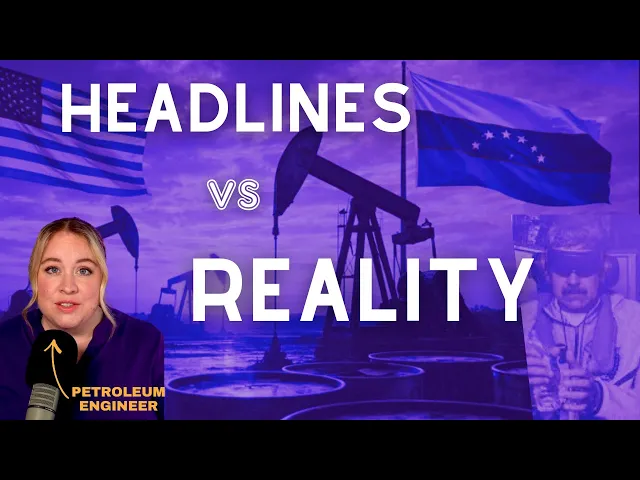
Venezuela, Oil Markets, and What Actually Matters

Tracy Lenz, PE, CMA
Certified Minerals Appraiser and Professional Engineer
Over the past week, headlines about Venezuela have escalated quickly. As someone who works in oil and gas engineering and valuation every day, I wanted to step away from political narratives and look at the situation through a practical lens:
What does this mean for oil supply, markets, and pricing?
This article summarizes the key questions I explored in my recent livestream and what the data actually supports.
Why This News Matters for Energy Markets
Any major change involving Venezuela immediately raises eyebrows in energy markets for one simple reason:
Venezuela holds some of the largest oil reserves in the world.
When news breaks involving leadership, sanctions, or foreign involvement, the market’s concern is not political ideology. The real questions are:
Will production increase or decrease?
Will exports change?
Does this impact global supply?
Could this influence oil prices?
That is the lens I use throughout this analysis.
Has Venezuela Always Been in This Situation?
Short answer: no.
Venezuela was once a reliable and major oil producer with world-class infrastructure and strong technical talent. Production decline over the past two decades is not due to lack of reserves. It is due to a combination of:
Mismanagement of national oil company operations (PDVSA)
Loss of technical workforce
Underinvestment in infrastructure
Political instability
Sanctions restricting trade and investment
This distinction matters because reserves in the ground do not equal barrels on the market.
Why Venezuela’s Production Is So Low Despite Massive Reserves
Venezuela’s challenges are not geological. They are operational:
Aging facilities that require major capital investment
Heavy oil that requires specialized processing and blending
Limited access to parts, chemicals, and expertise
Capital flight and limited reinvestment
Sanctions complicating financing and logistics
Even if sanctions disappeared overnight, meaningful production increases would take years, not months.
What Sanctions Actually Do (and Do Not Do)
Sanctions are often misunderstood.
Energy-related sanctions generally impact:
Who can purchase Venezuelan crude
Whether foreign companies can invest capital
Whether revenues can be transferred to PDVSA
How equipment, financing, and services move into the country
They do not magically stop oil production, and they do not automatically restart production either. What they do is influence how much outside capital and expertise can participate in rebuilding operations.
Chevron’s Role in Venezuela
Chevron’s presence has drawn particular attention.
Chevron operates through joint ventures that were established long before recent political developments. Under current licenses, Chevron is allowed to:
Operate existing joint ventures
Export oil produced from those projects
Recover certain costs
But they are not allowed to freely expand operations, pay dividends to PDVSA, or invest without constraints. This means:
Chevron can help stabilize existing production
Chevron cannot rapidly scale Venezuela’s total output
This is a stabilizing influence, not a production boom.
Why Chevron Is Uniquely Positioned Compared to Other Companies
Chevron has something most companies no longer have in Venezuela:
institutional continuity.
They never fully exited the country, they understand the assets, and they maintained relationships. That makes them operationally positioned in a way other majors are not. However, even with that advantage, there are still practical limits to what can be accomplished.
Where Venezuelan Oil Actually Goes
Another misconception is that Venezuelan oil automatically flows to the U.S. market.
In reality, Venezuelan exports have been diversified for years, with barrels flowing to:
Asia (notably China)
Parts of Europe
Regional trading partners
Limited volumes to the U.S. under specific licenses
Changes in Venezuelan exports tend to reshuffle trade routes more than they reshape global supply.
Will Venezuelan Oil Affect Global Prices?
This is the core market question.
The honest answer:
Only at the margins in the near term.
Why?
Venezuela cannot rapidly add meaningful new production
Infrastructure constraints are severe
Investment timelines are long
Global supply is influenced far more by OPEC policy, U.S. shale activity, and geopolitical disruptions elsewhere
Markets care about expectations, so headlines can move prices temporarily. But long-term pricing impact depends on actual barrels, not speculation.
How Fast Can Markets Adapt to Supply Changes?
Oil markets are surprisingly adaptive.
When supply disruptions occur, the market responds through:
Storage adjustments
Refinery feedstock substitutions
Shifts in trade routes
Incremental production changes elsewhere
This adaptability is why dramatic headlines do not always translate into dramatic price movements.
Final Takeaway: Separate Headlines from Fundamentals
The most important conclusion from all this research is simple:
Venezuela is a long-term story, not a short-term supply shock.
There is no scenario where Venezuelan production suddenly returns to historical levels without:
Massive capital investment
Major infrastructure rebuilding
Workforce redevelopment
Multi-year timelines
That does not mean Venezuela is irrelevant. It means we should treat it with realism rather than hype.
If You Want the Full Deep Dive
This article is based on a longer recorded livestream where I walk through the topic step-by-step, answering common questions and explaining the engineering and market mechanics behind the headlines.
You can watch the full video here:
References
Ambrose, Jillian. “Dense, Sticky and Heavy: Why Venezuelan Crude Oil Appeals to US Refineries.” Business. The Guardian, January 5, 2026. https://www.theguardian.com/business/2026/jan/05/venezuelan-crude-oil-appeals-to-us-refineries.
“Animation of 2015 Explosion at ExxonMobil Refinery in Torrance, CA - YouTube.” Accessed January 10, 2026. https://www.youtube.com/watch?v=JplAKJrgyew.
Dewey, Caitlin. “America’s Century-Long Interest in Venezuelan Oil.” Vox, January 5, 2026. https://www.vox.com/today-explained-newsletter/474027/venezuela-oil-industry-trump.
“Energy & Financial Markets: What Drives Crude Oil Prices? - Energy Information Administration.” Accessed January 10, 2026. https://www.eia.gov/finance/markets/crudeoil/
“Ex-Chevron Executive Seeks $2bn for Venezuelan Oil Projects : R/Economics.” Accessed January 10, 2026. https://www.reddit.com/r/Economics/comments/1q4o3to/exchevron_executive_seeks_2bn_for_venezuelan_oil/.
“Frequently Asked Questions (FAQs) - U.S. Energy Information Administration (EIA).” Accessed January 8, 2026. https://www.eia.gov/tools/faqs/faq.php?id=29&t=6.
Graphic News. “CONFLICT: U.S. Lays Claim to Venezuelan Oil Assets Infographic.” Accessed January 10, 2026. https://www.graphicnews.com/en/pages/47657/conflict-us-lays-claim-to-venezuelan-oil-assets.
Haddad, Mohammed. “Venezuela Has the World’s Most Oil: Why Doesn’t It Earn More from Exports?” Al Jazeera. Accessed January 10, 2026. https://www.aljazeera.com/news/2025/9/4/venezuela-has-the-worlds-most-oil-why-doesnt-it-earn-more-from-exports.
Hals, Tom, and Andrew Goudsward. “Was the US Capture of Venezuela’s President Legal?” United States. Reuters, January 5, 2026. https://www.reuters.com/world/us/was-us-capture-venezuelas-president-legal-2026-01-03/.
John, Noel. “Oil Prices Forecast to Ease in 2026 under Pressure from Ample Supply.” Energy. Reuters, January 5, 2026. https://www.reuters.com/business/energy/oil-prices-forecast-ease-2026-under-pressure-ample-supply-2026-01-05/.
Leeja Miller. “The Context You Need To Know About Maduro’s Capture EXPLAINED.” Accessed January 10, 2026. https://www.leejamiller.com/episodes/2026/1/5/the-context-you-need-to-know-about-maduros-capture-explained.
Levitz, Eric. “Did Trump Really Invade Venezuela for Oil?” Vox, January 5, 2026. https://www.vox.com/politics/473986/maduro-venezuela-invasion-war-trump-oil
Mccartney, Georgina. “Oil Settles $1 Higher as Traders Assess Venezuela Upheaval.” Energy. Reuters, January 5, 2026. https://www.reuters.com/business/energy/oil-prices-slip-ample-supply-despite-political-turmoil-venezuela-2026-01-04/.
“Much of the Country’s Refinery Capacity Is Concentrated along the Gulf Coast - U.S. Energy Information Administration (EIA).” Accessed January 10, 2026. https://www.eia.gov/todayinenergy/detail.php?id=7170.
Oil, Keefe Borden, and Gas Facilities. “The Challenges of Processing and Transporting Heavy Crude.” JPT, September 12, 2013. https://jpt.spe.org/challenges-processing-and-transporting-heavy-crude.
Organization of the Petroleum Exporting Countries. “Venezuela.” Accessed January 10, 2026. https://www.opec.org/venezuela.html.
“PADD Regions Enable Regional Analysis of Petroleum Product Supply and Movements - U.S. Energy Information Administration (EIA).” Accessed January 10, 2026. https://www.eia.gov/todayinenergy/detail.php?id=4890.
Piña-Acuña, Gloria, and Diomar Ferreira. “Well-Testing Challenges of the Hamaca Project, Orinoco Heavy Oil Belt, Venezuela.” n.d. Accessed January 10, 2026. https://dx.doi.org/10.2118/86930-MS.
“Regional Refinery Trends Evolve to Accommodate Increased Domestic Crude Oil Production - U.S. Energy Information Administration (EIA).” Accessed January 10, 2026. https://www.eia.gov/todayinenergy/detail.php?id=19591.
secondaryscience4all. “Fractional Distillation of Crude Oil (GCSE).” Secondary Science 4 All, July 28, 2014. https://secondaryscience4all.wordpress.com/2014/07/28/fractional-distillation-of-crude-oil/.
Tan, Florence, and Anjana Anil. “Small Rise in Venezuelan Oil Supply Possible over next Two Years, Analysts Say.” Energy. Reuters, January 5, 2026. https://www.reuters.com/business/energy/us-sanctions-policy-determine-venezuelas-oil-production-outlook-goldman-says-2026-01-04/.
“The Challenges of Processing and Transporting Heavy Crude.” Accessed January 10, 2026. https://jpt.spe.org/challenges-processing-and-transporting-heavy-crude
“The Ultimate Guide to Distillation and Distillation Columns.” Accessed January 8, 2026. https://www.gustawater.com/blog/distillation-column.html.
Latest posts
Browse more from our blog
News, videos, tips, guides, industry best practices, and other updates.

Tracy Lenz, PE, CMA
·
Oklahoma Forced Pooling: Why You Got the Letter
Lorem ipsum dolor sit amet, consectetur adipiscing elit, sed do eiusmod tempor incididunt ut labore et dolore magna aliqua. Ut enim ad minim veniam, quis nostrud exercitation ullamco laboris nisi ut aliquip ex ea commodo consequat. Duis aute irure dolor in reprehenderit in voluptate velit esse cillum dolore eu fugiat nulla pariatur. Excepteur sint occaecat cupidatat non proident, sunt in culpa qui officia deserunt mollit anim id est laborum.
Tracy Lenz, PE, CMA
·
Venezuela, Oil Markets, and What Actually Matters
Over the past week, headlines about Venezuela have escalated quickly. As someone who works in oil and gas engineering and valuation every day, I wanted to step away from political narratives and look at the situation through a practical lens: What does this mean for oil supply, markets, and pricing? This article summarizes the key questions I explored in my recent livestream and what the data actually supports.
Tracy Lenz, PE, CMA
·
10/21/25 Office Hours Q&A
Welcome to our Office Hours Live Stream, where I’ll be taking your questions,big or small,on anything oil & gas! Whether you’re curious to hear our frequently asked questions (FAQs) or want to submit something new in the chat, this session is a great opportunity to get real-time insights and practical tips.